

Numbers on a page rarely mean much until you connect them to something you can picture. Tell someone a hallway is “152 meters long,” and their eyes glaze over. Tell them it is “the length of a cruise ship,” and suddenly they get it. That is exactly what were doing here with 500 feet, a distance that shows up more often than you’d think in construction, sports, aviation, and even nature.
By the end of this guide, you will not just know what 500 feet is in numbers. You will know what it feels like, because you will have eighteen real-world examples to anchor it to.
How Long Is 500 Feet, Really?
Let us start with the basics. 500 feet is a unit of length in the imperial measurement system, commonly used across the US, UK, and a handful of other countries. Here is the plain definition:
- 500 feet equals one-sixth of a mile, roughly
- It is longer than a standard city block in most US cities
- It is short enough to walk in under two minutes but long enough to dwarf most homes
The tricky part is not the definition. It is the mental math. Most of us do not walk around with a mental ruler, so a number like “500” does not automatically translate into a felt sense of space. That is where comparisons come in, and we will get to those shortly.
500 Feet Quick Conversion Chart
Before we jump into real-world examples, here is a fast reference table so you can convert this distance into whatever unit you are more comfortable with.
| Unit | Equivalent to 500 Feet |
|---|---|
| Yards | 166.67 yards |
| Meters | 152.4 meters |
| Miles | 0.0947 miles |
| Inches | 6,000 inches |
| Kilometers | 0.1524 kilometers |
Keep this table bookmarked. It comes in handy for everything from home renovation projects to figuring out how far away that “no parking within 500 feet” sign actually applies.
Sports & Recreation Comparisons
Sports fields and tracks give you some of the clearest yardsticks out there, since they’re built to exact, standardized dimensions.
1. A Football Field and a Half

An American football field, including the end zones, measures 360 feet. Stretch that out by another 140 feet, and you have got your 500-foot distance. Picture standing at one end zone and looking clear past the opposite one, then adding almost half a field’s worth of extra turf.
2. Three and a Half Olympic Pools Lined Up
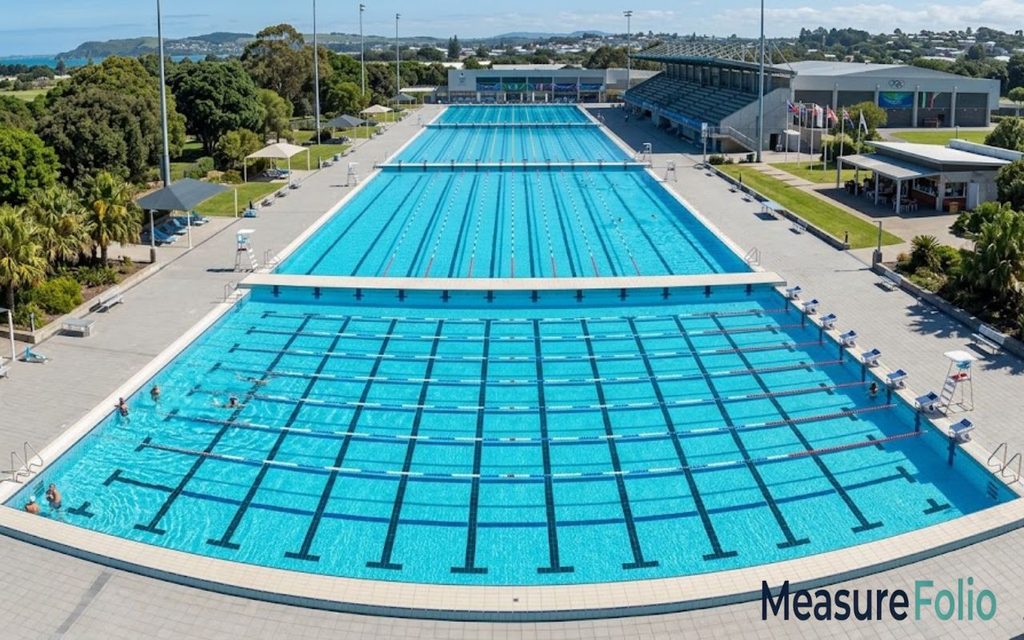
A regulation Olympic swimming pool runs 164 feet long. Line up three and a half of them end to end, and you will hit roughly 500 feet. That is a lot of chlorine, and it’s also a useful way to picture just how far a strong swimmer covers in a single distance event.
Next time you watch an open-water race, remember they’re often covering several of these lengths without ever touching a wall.
3. Half a Standard Running Track
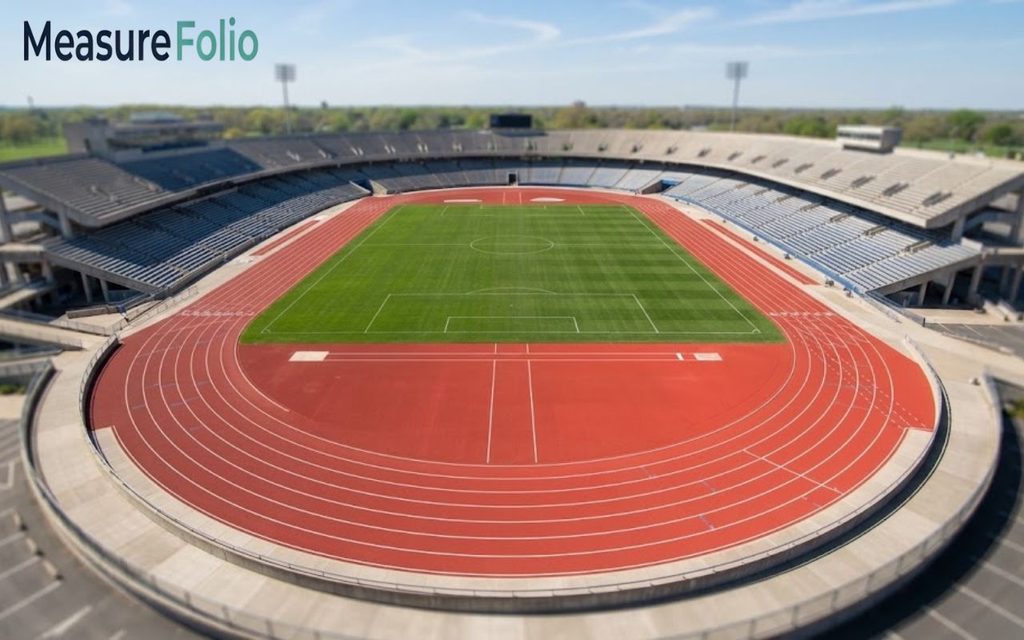
A standard outdoor running track measures 1,312 feet around (400 meters). Half a lap gets you close to 500 feet, which is why sprinters treat the 400-meter dash as such a grueling middle-distance event.
It is basically a full loop at a dead sprint, and most runners hit a wall of lactic acid burn right around that halfway mark. Coaches often use this exact stretch to train speed endurance because it punishes pacing mistakes fast.
Buildings & Skyline Landmarks at 500 Feet
Nothing captures scale quite like looking up, so let’s measure 500 feet against the things that define city skylines.
4. A 45-Story Skyscraper Standing Tall

Most commercial high-rises average around 11 to 12 feet per floor once you factor in ceiling height and structural elements. Do the math, and a 500-foot building lands somewhere around 45 stories, comparable to many mid-tier skyscrapers found in cities like Chicago, Miami, or Houston.
5. The Upper Third of the Eiffel Tower

The Eiffel Tower stands 1,083 feet tall. Its top third, from roughly the second observation deck up to the antenna, measures close to 500 feet on its own. That is a striking way to think about just how massive the full structure really is, especially since most tourists never make it past the second level. The antenna alone accounts for a good chunk of that final stretch.
6. The Full Width of the Gateway Arch’s Base

St. Louis’s Gateway Arch has a base span of 630 feet, but if you are picturing the width across its footing minus some margin, you land right in 500-foot territory. It is one of the few monuments where height and width are almost mirror images of each other.
Vehicles & Transportation
Cars, ships, and planes move through 500-foot spans every day, often without anyone on board giving it a second thought.
7. Thirteen School Buses Bumper to Bumper

A standard school bus measures about 40 feet long. Line up thirteen of them nose to tail, and you will stretch just past 500 feet. Next time you are stuck behind a school bus, imagine a baker’s dozen of them ahead of you, blinkers flashing the whole way down the block. It’s a surprisingly common backup on narrow residential streets during morning drop-off.
8. One Modern Cargo Ship’s Length

Many container ships used in global shipping fall between 400 and 500+ feet, particularly mid-sized vessels used for regional freight. The massive Maersk Triple E class ships, by comparison, run closer to 1,300 feet, so a 500-foot vessel is a modest-sized workhorse rather than a mega-ship.
9. A Section of Airport Taxiway
Airport taxiways are built in segments, and a 500-foot stretch is a common measurement used in ground traffic planning. Pilots and ground crews reference these segments constantly when coordinating aircraft movement between runways and gates.
Nature’s Giants Measuring 500 Feet
The natural world has its own supersized rulers, from ocean giants to trees that have been growing for centuries.
10. Six Blue Whales Nose to Tail

A blue whale, the largest animal to have ever lived, averages about 80 to 90 feet in length. Line up six of them, and you are right around 500 feet. It is a genuinely humbling way to grasp both the whale’s size and the distance itself.
11. A Grove of Ancient Redwood Trees

Coast redwoods are among the tallest living organisms on Earth, with some specimens reaching heights over 350 feet. A cluster of several mature redwoods, measured across their combined canopy spread or height, can easily approximate 500 feet of vertical or horizontal scale.
12. A Loaded Ocean-Going Barge

Industrial barges used for hauling freight, grain, or fuel often run in the 195 to 200-foot range individually, but when linked together in tow configurations (a common practice on rivers like the Mississippi), a string of barges frequently exceeds 500 feet in total length.
City Layout: 500-Foot Public Spaces
Step outside, and you’ll find 500 feet baked into the very layout of the streets and sidewalks around you.
13. Roughly Three City Blocks
City block length varies by location, but in many US cities, a standard block runs somewhere between 200 and 300 feet. Three blocks strung together typically lands you close to 500 feet, give or take, depending on the city’s grid layout.
14. A Long Downtown Street Segment

Beyond blocks, a single continuous downtown street segment, measured from one major intersection to the next, frequently spans 500 feet in dense urban cores like Manhattan or downtown Chicago.
That stretch is often packed with storefronts, crosswalks, and enough foot traffic to make it feel much longer than it actually is. Delivery trucks, cyclists, and pedestrians all compete for the same real estate along the way. It’s a small distance that carries a disproportionate amount of city life.
15. A Full-Length Public Fishing Pier

Public piers built for fishing and recreation often stretch to five hundred feet or more, giving anglers enough reach to fish past the shallow shoreline waters and into deeper, fish-rich zones.
Walking to the very end can take a couple of minutes, but it’s worth it once the bigger catches start biting further out. Many coastal towns treat these piers as a defining landmark. They’re often just as popular for sunset walks as they are for actual fishing.
Engineering & Modern Marvels
Modern engineering pushes 500 feet in directions nature never did, spinning it, stretching it, and pointing it at the stars.
16. A Single Wind Turbine Blade Span

Modern wind turbine blades used in utility-scale energy production can reach lengths of 200 feet or more per blade. When you account for the full rotor diameter, the swept area of a large turbine’s blades can span close to 500 feet in diameter, an often-overlooked fact about renewable energy infrastructure.
17. The Reach of a Large Radio Telescope Dish

Some of the world’s largest radio telescopes, like China’s FAST telescope, have dish diameters exceeding 1,600 feet, but mid-sized research telescopes commonly fall in the 500-foot range. These instruments are critical for astronomical research, capturing faint radio signals from deep space.
18. The Taxi Distance of an Airbus A380 Before Takeoff

While the Airbus A380 itself measures about 239 feet in length, ground crews and pilots often reference 500-foot taxi segments when calculating runway positioning and takeoff sequencing at busy international airports. It is a distance embedded in daily aviation logistics, even if passengers never think about it.
Why Visualizing Distance Matters
“The mind thinks in pictures, not numbers.”
That old saying holds up surprisingly well when it comes to measurement. Architects, urban planners, and engineers rely on visual comparisons constantly, not because they can not do the math, but because clients, city councils, and everyday people understand scale far better through familiar references.
Whether you are planning a construction project, hiking a trail with distance markers, or just trying to figure out how far “500 feet from the property line” actually is, having a mental library of comparisons like the ones above makes real-world decisions faster and more intuitive.
Quiz: Test Your Knowledge on 500 Feet
Put your knowledge to the test with our quick quiz below. Answer a few questions and see how you score!
1. How many yards are in 500 feet?
A) 100 yards
B) 133.33 yards
C) 166.67 yards
D) 200 yards
2. Approximately how many blue whales lined up nose to tail would equal 500 feet?
A) Three
B) Four
C) Five
D) Six
3. What is the maximum legal altitude for recreational drones under standard FAA rules?
A) 300 feet
B) 400 feet
C) 500 feet
D) 600 feet
4. Roughly how many steps does it take the average adult to walk 500 feet?
A) 100 steps
B) 150 steps
C) 200 steps
D) 250 steps
5. How many stories does a typical 500-foot building have?
A) 25 to 30 stories
B) 30 to 35 stories
C) 40 to 45 stories
D) 50 to 55 stories
Answers
- C) 166.67 yards
- D) Six
- B) 400 feet
- C) 200 steps
- C) 40 to 45 stories
Final Thoughts
500 feet is not just an abstract measurement buried in a textbook. It is the length of a cruise ship, the span of a wind turbine’s blades, the distance six blue whales would cover if they lined up nose to tail. Once you attach real-world images to a number, it stops being just a number and starts becoming something you actually understand.
Next time someone mentions this distance, you will not need a calculator. You will already have a picture in your head.
FAQs About 500 Feet
Got questions? We’ve got answers — check out the most common ones below.
1. How long does it take to walk 500 feet?
At an average walking pace of about 3 to 4 feet per second, most people cover five hundred feet in roughly 2 to 3 minutes, depending on terrain and pace.
2. Is 500 feet enough distance for a drone to fly legally?
In the US, the FAA generally allows recreational drones to fly up to 400 feet in altitude, so five hundred feet actually exceeds the standard legal ceiling for most hobbyist drone operations without special authorization.
3. How many parking spaces fit within 500 feet?
Standard parking spaces run about 18 to 20 feet long, meaning roughly 25 to 27 cars could park bumper to bumper across a 500-foot stretch.
4. Can you see 500 feet away clearly with the naked eye?
Yes, under normal daylight conditions, the human eye can easily distinguish objects and even read large signage from five hundred feet away, though fine details like small text become difficult to make out past 100 to 150 feet.
5. How does 500 feet compare to a typical residential street length?
Most residential streets in suburban neighborhoods run between 300 and 600 feet from one intersection to the next, placing a 500-foot stretch right in the middle of a typical block length.

Hi there, I’m Elanor Albert, the admin for the Measurements category here at Measure Folio. I believe that getting the exact numbers shouldn’t be a struggle. My goal is to share simple, accurate guides and tool reviews so you can measure with absolute confidence. I’m thrilled to help you master the art of precision!